Flagship capability
Radar Cross Section and signature measurement
NORRAD measures what targets actually scatter — across frequency, aspect angle and polarisation — and explains what the result means for radar detection, classification and system performance.
Current measurement capability
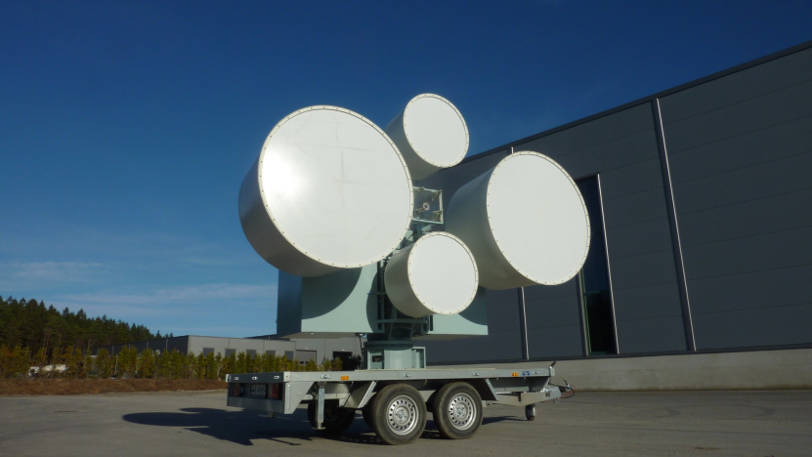
NORRAD provides 2–40 GHz wideband radar measurement of radar cross section and radar signatures, covering the full chain from measurement planning through calibration to interpretation of the delivered data.
- 2–40 GHz wideband measurement
- RCS measurement
- target signature characterisation
- measurement planning
- frequency-dependent RCS analysis
- aspect-angle analysis
- polarisation-dependent measurement
- reference reflector calibration
- measurement validation
- signature interpretation
- technical advice on radar signatures
Techniques
How the measurement is made
Coherent measurement
Amplitude and phase are preserved through the measurement chain, allowing scattering-centre behaviour and high-resolution signature analysis rather than a single average number.
Wideband 2–40 GHz
Frequency-dependent RCS across a wide band, so target behaviour can be assessed against the actual bands of the radars that must detect or classify it.
Polarimetric measurement
HH, VV and cross-polarised responses, revealing scattering mechanisms that a single-polarisation measurement hides.
Bistatic geometry
Measurement where transmitter and receiver are separated, characterising targets under geometries that monostatic data cannot predict.
Frequency-agile operation
Agile waveforms for measurement robustness and for resolving target response over frequency.
Aspect-angle measurement
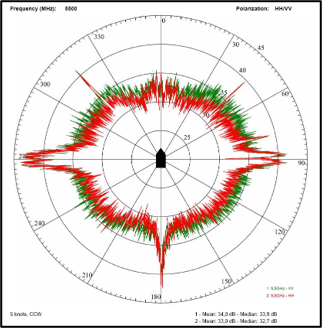
RCS as a function of azimuth and target aspect, delivered as polar signatures with statistics such as mean and median level.
Result
Data you can defend
An RCS number is only worth as much as its calibration and its error budget. Every campaign is built around traceable reference measurement and an explicit account of what limits the accuracy of the result.
- Reference reflector measurement and calibration of absolute RCS level
- Multipath and ground-interaction assessment for the chosen measurement geometry
- Environmental and propagation effects on measured level
- Measurement accuracy, repeatability and uncertainty
- Validation of measured data against expected scattering behaviour
- Reporting that a radar engineer, a programme manager and a procurement team can each use
Have a difficult radar or RF problem?
Describe the system, the measurement or the question. You will get a direct technical answer from an engineer, not a sales response.